1990s — 2016
Origins
Paris streets, Beijing practice, Songzhuang exhibition, then Los Angeles.
Paris · 1990s
Graffiti in the Paris scene under another name.
Beijing · 2007
Professional fine-art practice begins as SMAB — surreal acrylics, oil portraits, then textured abstraction. Shown in 798.
Songzhuang · 2010
Sunshine International Art Museum, main hall.
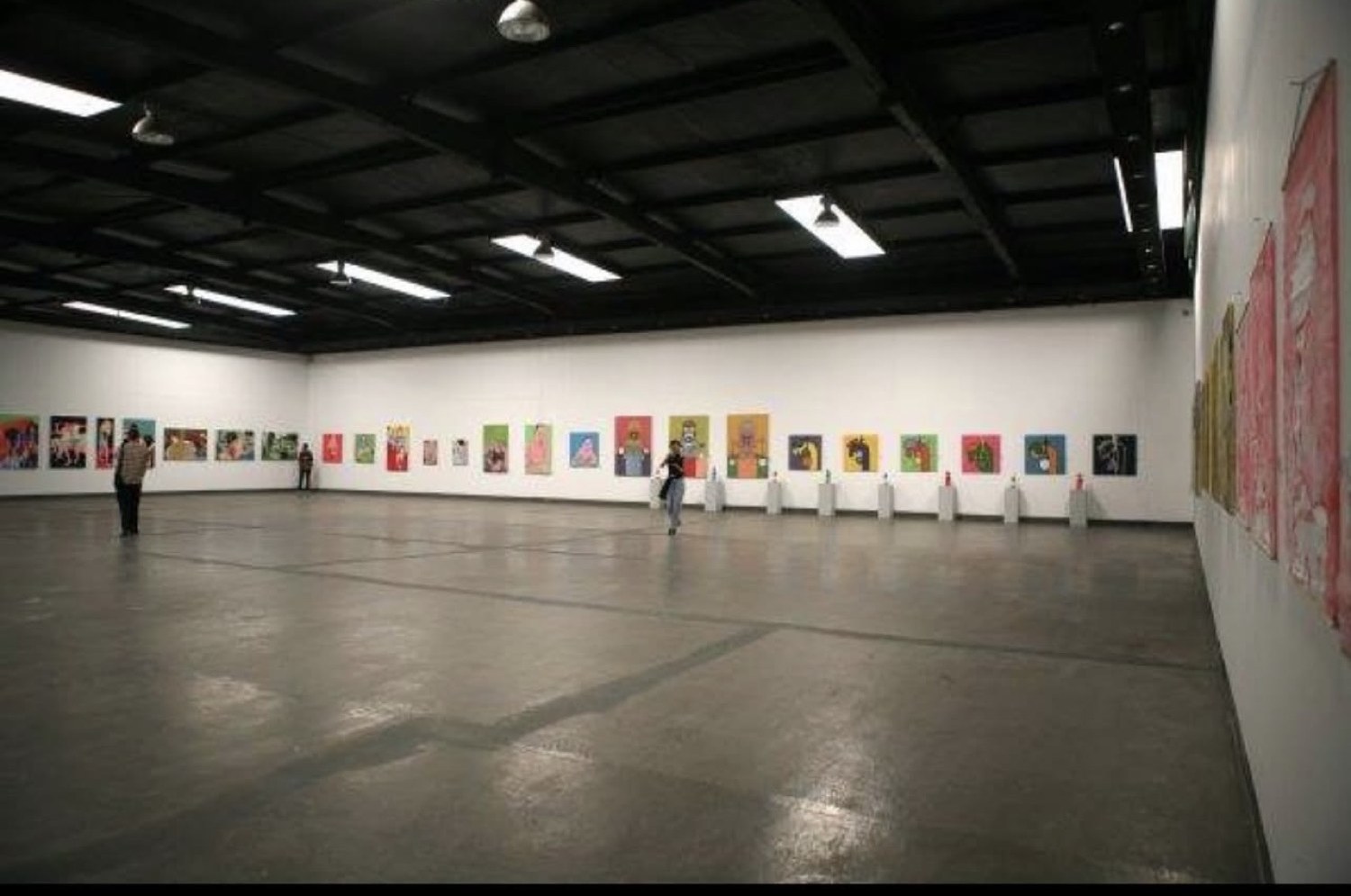
Los Angeles · 2016
Move to LA. Fluid mixed media on paper, then the Torii years.
Statement
Stance
SMAB paints thresholds that refuse resolution.
The work is not “street art in a gallery” and not decorative abstraction. It is a consistent polarity: turbulence versus a small, stubborn still point.
The torii (2018–24, revived in 2026 as Lucky 11) is a tiny architectural silhouette on a violent or weather-heavy field. In the paintings it is not Japanese décor. It is an anchor that stays small on purpose — a threshold that does not swallow the storm and is not swallowed by it.
The closed-eye face (Pill / Breakout) is inward attention, not sleep. The figure is absorbed in its own process; the viewer is not being performed for.
Flashback re-enters the 2008–09 Beijing abstract language with tighter structure and darker control: return with difference, not nostalgia.
Materials are straightforward: acrylic on canvas, usually 24 × 36 in, with physical texture, graphic color, and a pop-adjacent punch that still carries graffiti DNA (especially in the Hybrid works, where large SM letterforms share the surface with the small gate).
The stance of the work: intensity held, not resolved. The pill stays too big. The gate stays small. The eyes stay closed. That refusal is the subject.